Preventive Maintenance Checklist Template for Machines
Pick a machine type and get a ready PM checklist grouped into daily, weekly, monthly, quarterly and annual tasks. Edit any line, mark the result on the round, print it, or download the free Excel, PDF and Word files. No signup.
Updated October 2026
Build your checklist
Choose the machine. The tasks load below, grouped by frequency, and you can change every line.
Checklist: Pumps (centrifugal)
Edit the wording, move a task to another frequency, delete what does not apply, add your own. On the round, set each result to Done, Problem found or N/A and add a note. Your edits are saved in this browser only.
12 month PM calendar
Monthly, quarterly and annual checks due in each month; daily and weekly checks run all year on top. Set the months under Build your checklist.
Every operating day: 4 daily checks. Every week: 3 weekly checks. M = monthly, Q = quarterly, A = annual.
Download the template: Excel, PDF and Word
All three files hold the checklists for all 10 machine types, free and without signup. Pick the machine type on the cover sheet of the Excel file, print the PDF page for the machine you need, or edit the Word tables before you print.
Excel workbook (.xlsx)
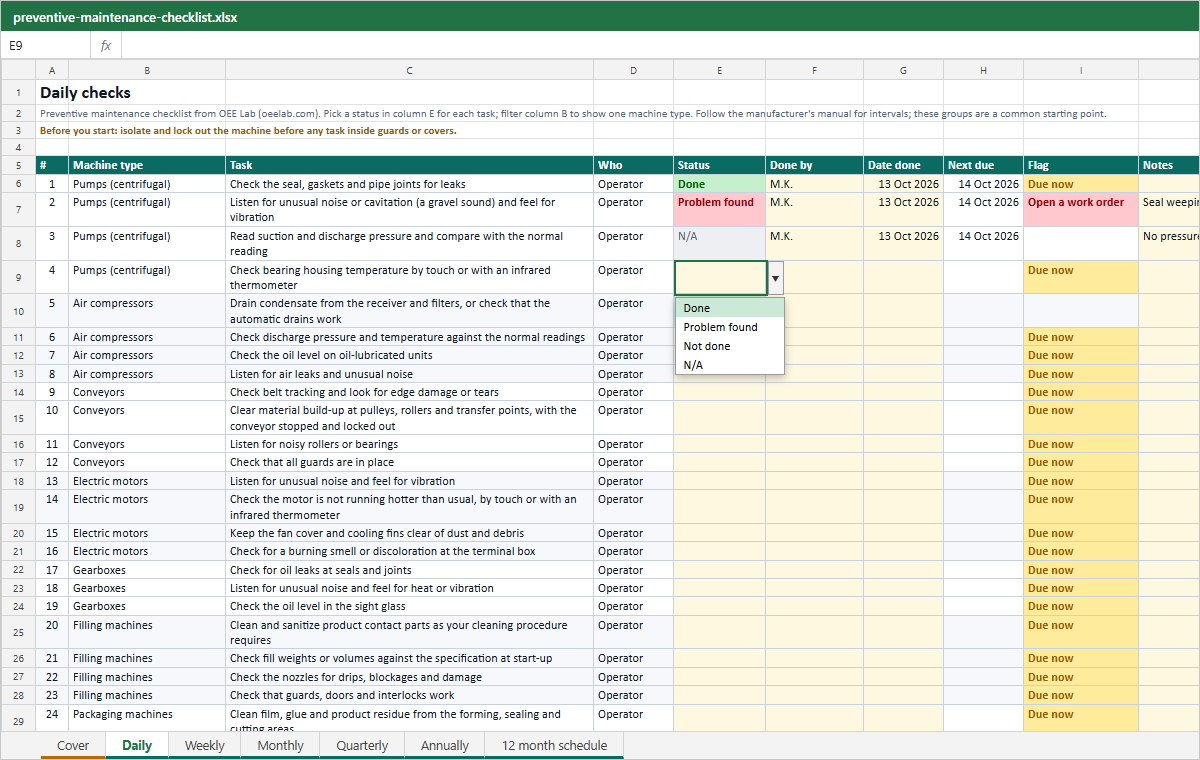
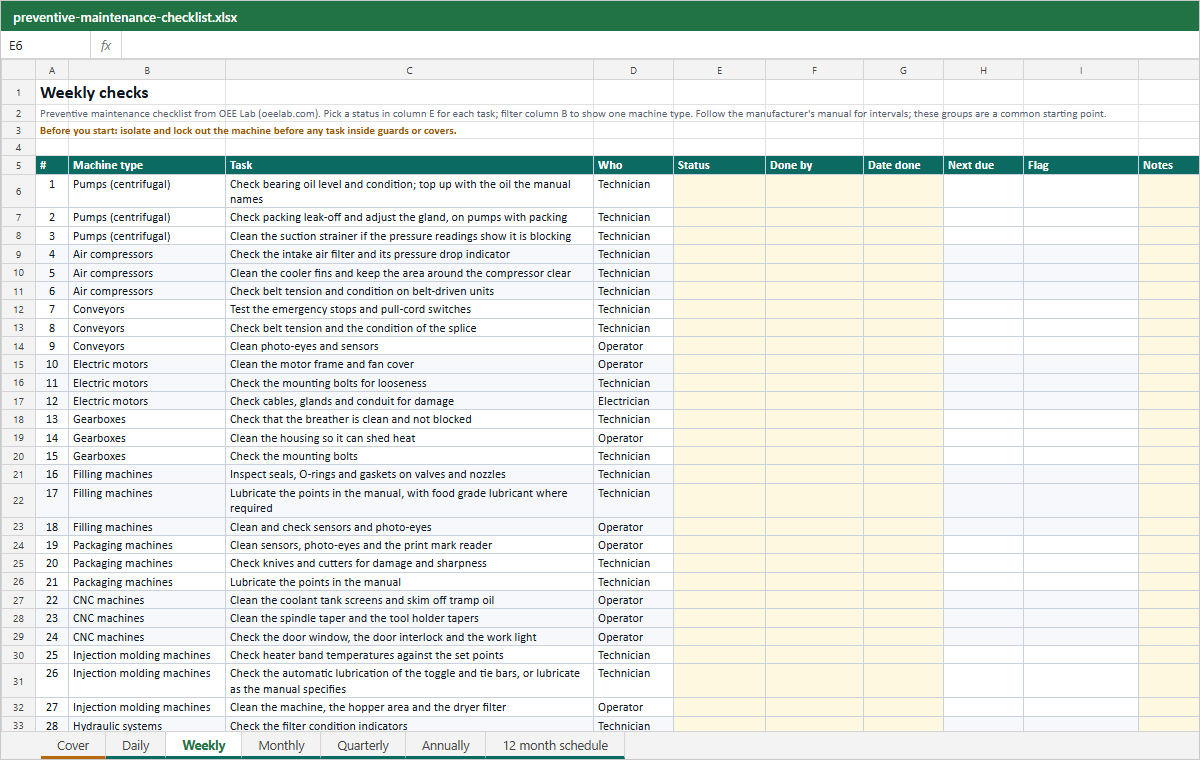
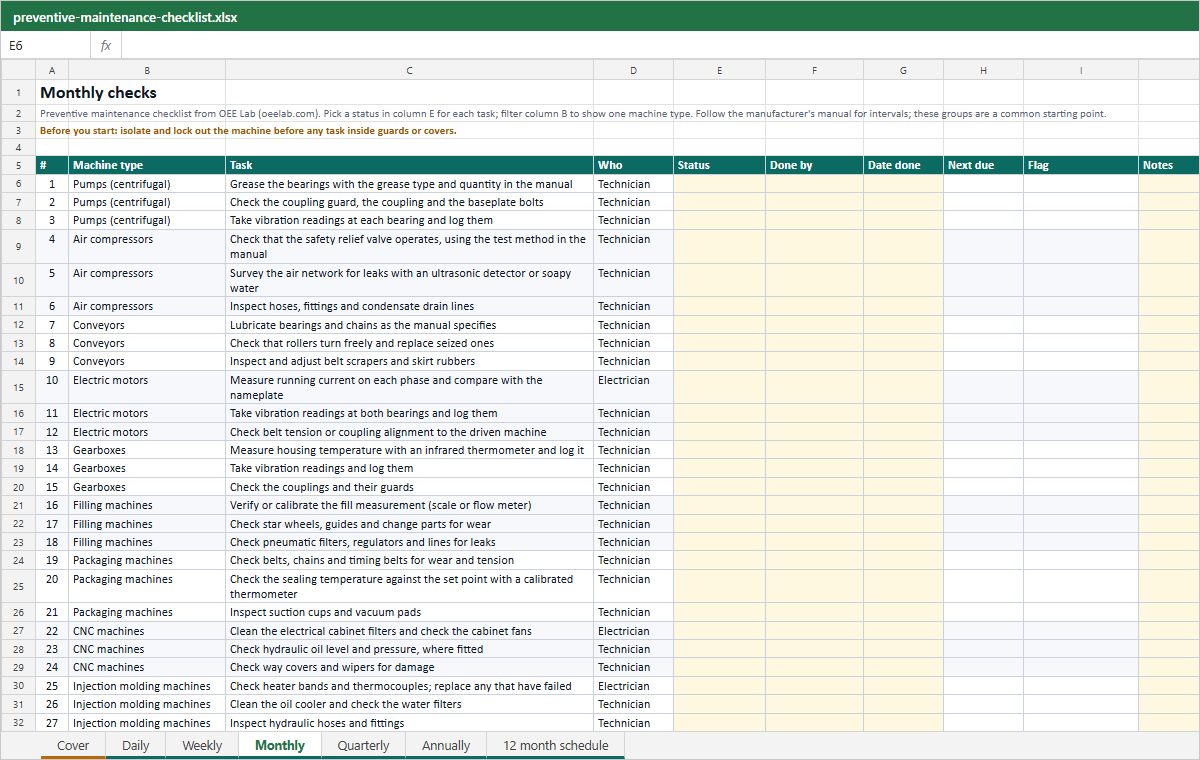
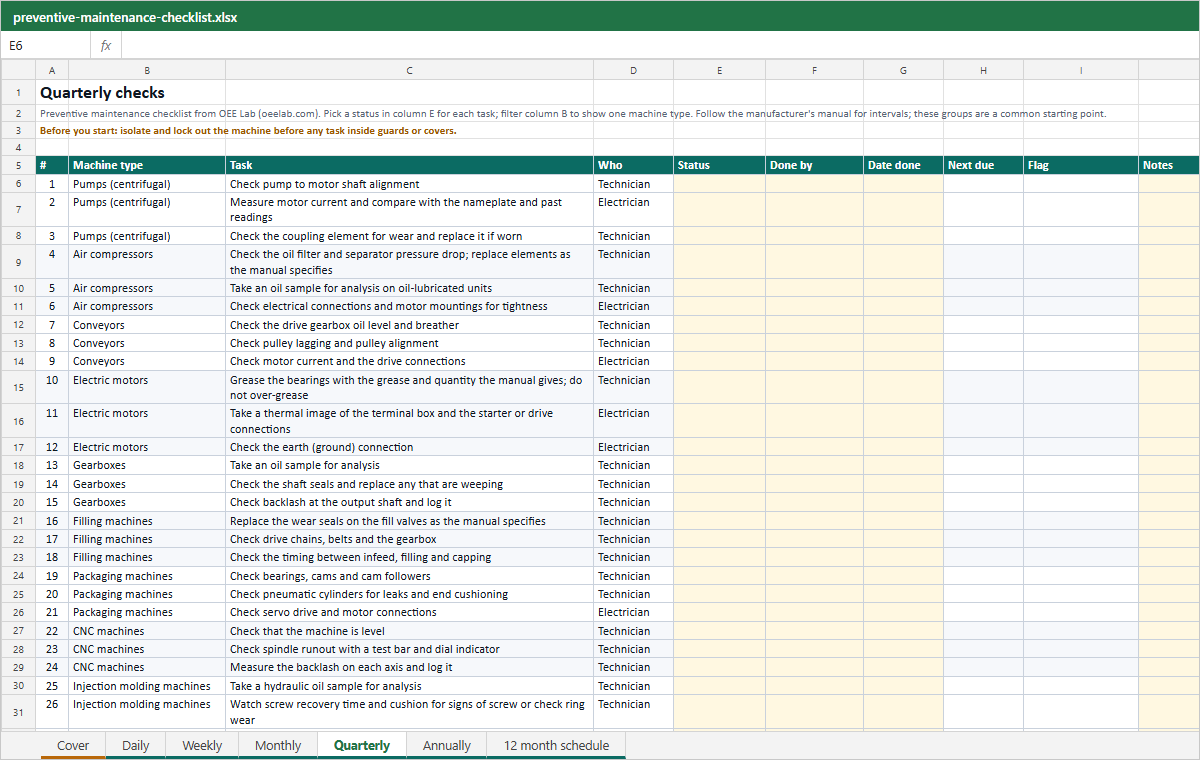
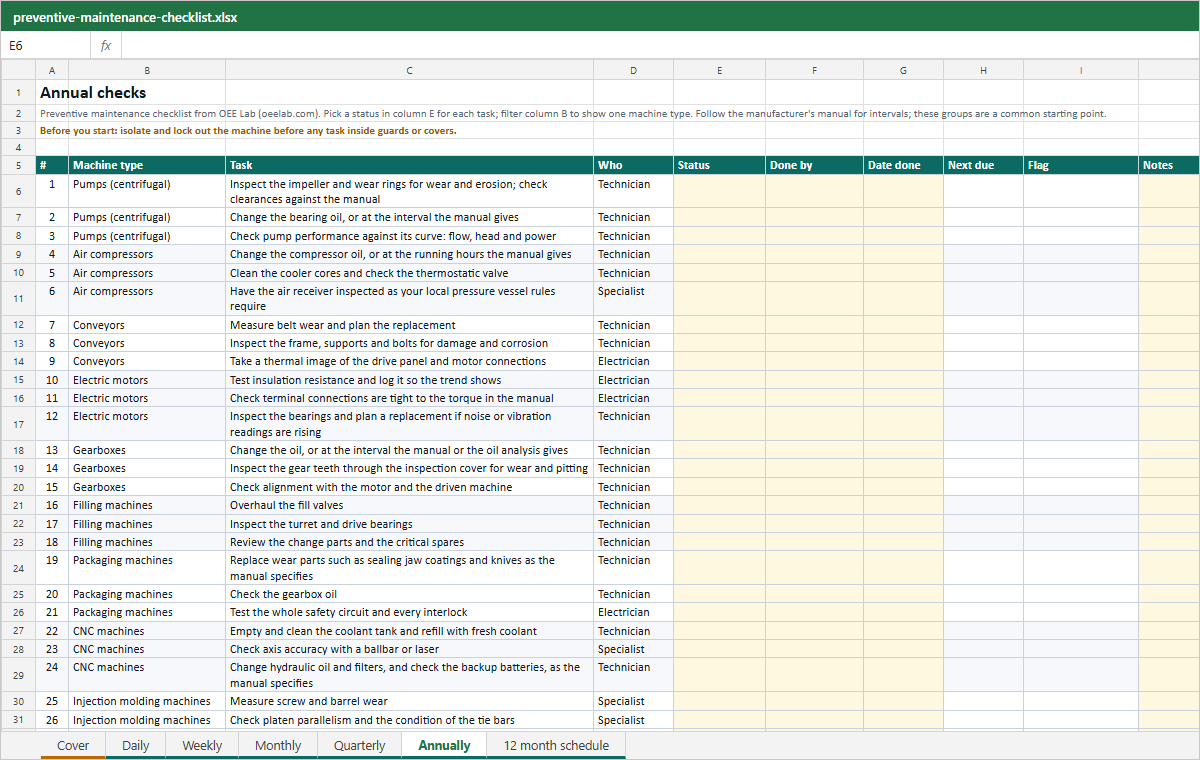
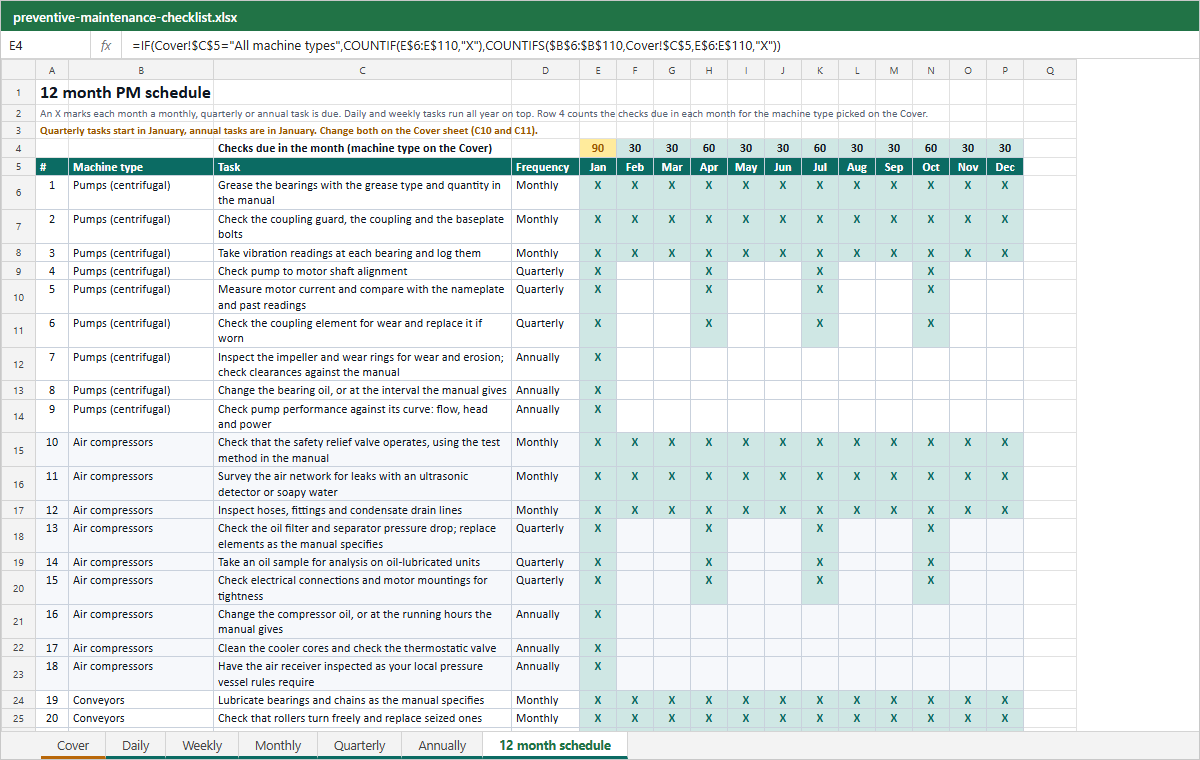
A cover sheet, one sheet per frequency from daily to annual, and a 12 month schedule that marks the months each task is due. Every task row has a status list (Done, Problem found, Not done, N/A), done by, date done, notes and a next due date that works itself out. The cover counts what is done and due for the machine type you pick. No macros.
Download Excel (.xlsx)Printable PDF
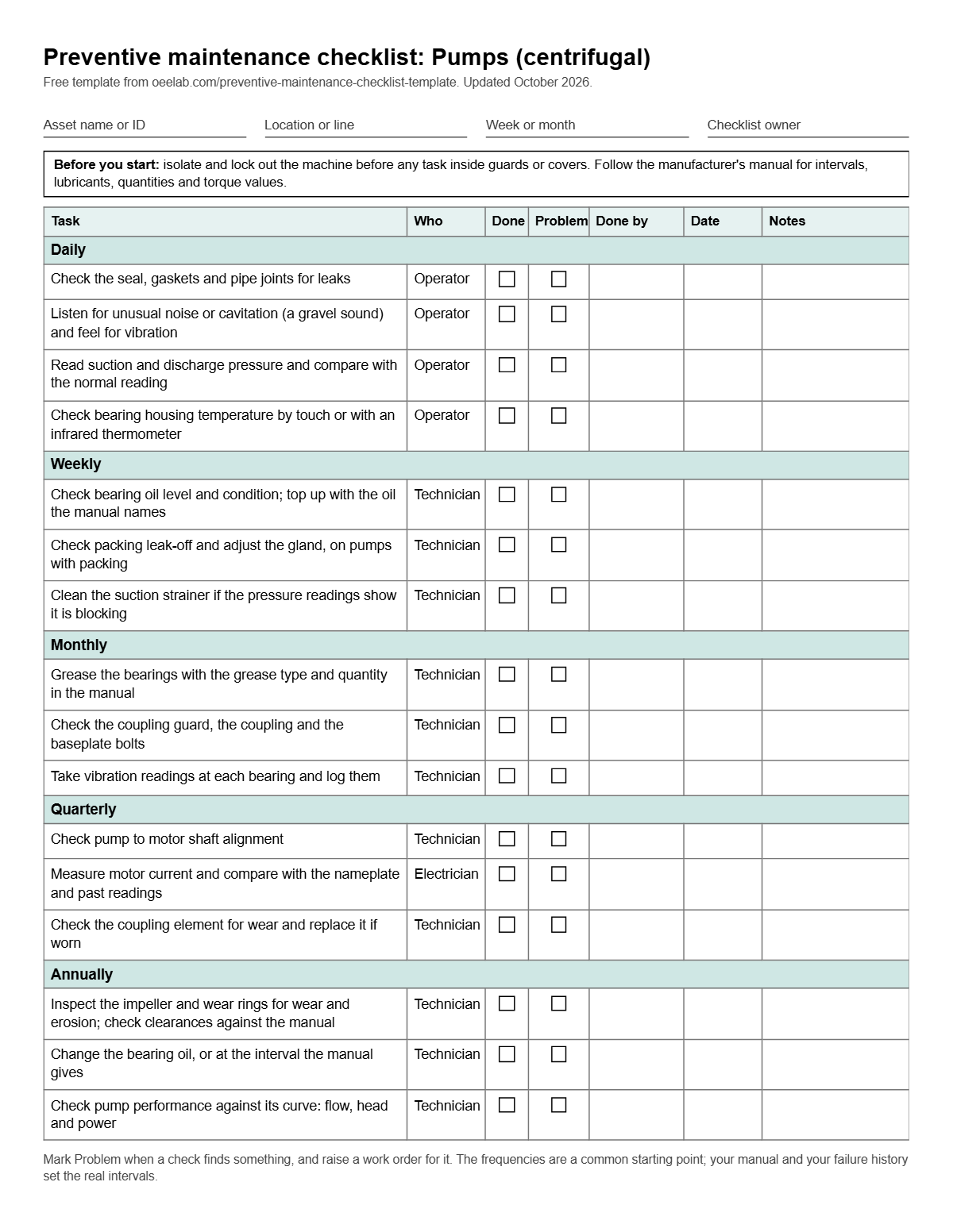
Ten printable pages, one per machine type, with all five frequencies, tick boxes for done and problem found, and space for who did it, the date and notes. Print the page for the clipboard on the machine, or use the Print checklist button above for your edited version.
Download PDFWord document (.docx)
The same ten pages as the PDF, as tables you can edit: task, who, done, problem, done by, date and notes. Change the wording for your model, add your own lines and your asset names in Word or Google Docs, then print it for the round.
Download Word (.docx)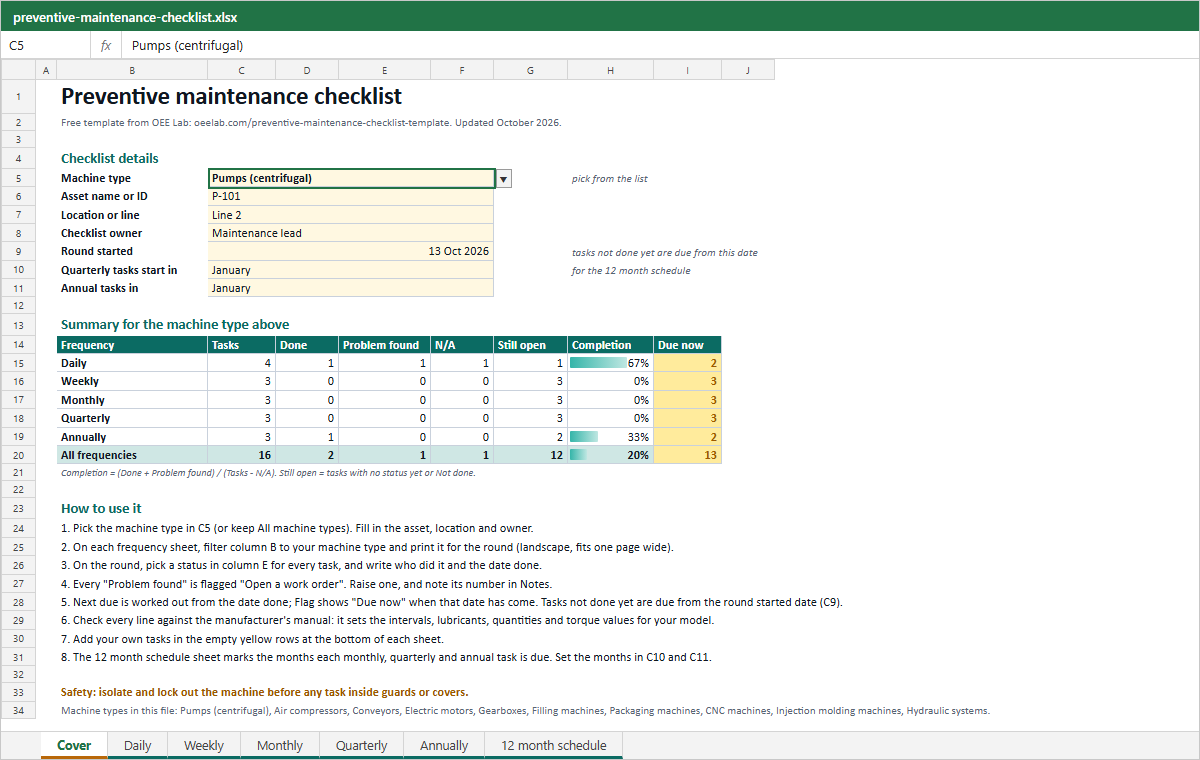
Keep this checklist going in the free CMMS
The free CMMS and OEE app from OEE Lab runs in your browser, and your data stays on your device. Set these tasks up as periodic plans for your machine there when you move off paper.
Open the free CMMS appA checklist only sees what someone writes down.
Fabrico, a light MES, tracks OEE and downtime live from PLCs, IoT sensors or AI cameras. Where cameras are fitted, the video of a stop sits next to its machine data, and a technician opens the work order from the stop. Data hosted in the AWS EU region; ISO 27001, ISO 9001 and ISO/IEC 20000-1.
Book a Fabrico demoWant help setting this up on your line?
Leave your work email if you would like the OEE Lab team to get in touch. To keep the checklist, use the Excel or PDF download, or Print checklist above.
No newsletter, no spam.
What goes on a preventive maintenance checklist
A preventive maintenance (PM) checklist is the list of routine tasks that keep a machine from failing: cleaning, inspecting, lubricating, adjusting, measuring and replacing wear parts before they break. Each line should answer five questions: what to do, on which machine, how often, who does it, and what was found.
- Task: one action per line, written so a new starter can do it. "Check the seal for leaks" beats "check pump".
- Frequency: daily, weekly, monthly, quarterly or annually. The groups are a common starting point; the manufacturer's manual sets the real intervals for your model.
- Who: operators take the daily look, listen and feel checks; technicians and electricians take the work that needs tools, measurements or a stopped machine.
- Result: done, problem found, not done or not applicable, with the name, the date and a note. A problem found becomes a work order.
How to use this template
- Pick the machine type. The builder loads the tasks for it, grouped daily to annually.
- Name the asset and location so the printout belongs to one machine, not a family of them.
- Check every line against the manual. Change the wording, move tasks between frequencies, delete what your model does not have and add what it needs.
- Print it or download the Excel file. Tick each task on the round, write who did it and when, and note anything you found.
- Act on findings and review the intervals. Every "problem found" becomes a work order; each quarter, compare the checklist with the failure history and adjust.
Worked example: the pump checklist this page opens with
The builder opens on a centrifugal pump with 16 tasks and 250 operating days a year. Here is how often each group comes round:
| Frequency | Tasks | Times a year | Task checks a year | Share |
|---|---|---|---|---|
| Daily | 4 | 250 | 1,000 | 82.9% |
| Weekly | 3 | 52 | 156 | 12.9% |
| Monthly | 3 | 12 | 36 | 3.0% |
| Quarterly | 3 | 4 | 12 | 1.0% |
| Annually | 3 | 1 | 3 | 0.2% |
| Total | 16 | 1,207 | 100% |
Four daily checks make 83% of everything done on this pump in a year. That is why the daily round belongs with the operator who runs the machine: it is short, it happens anyway, and it is where leaks, noise and heat show up first. Technicians take the other 207 checks, weekly to annual, with an electrician for the quarterly motor current reading. On the calendar, January carries 9 of those monthly to annual checks (3 monthly, 3 quarterly, 3 annual) against 3 or 6 in other months; moving the annual work to February spreads the load to 6 at most.
The 10 checklists, task by task
Every task in the builder, the Excel file, the Word file and the PDF, by machine type and frequency, with who usually does it. Load any list into the builder above to change it, mark the results and print it.
Pumps (centrifugal)
16 tasks
This checklist is open in the builder above. Go to the builder
Daily
- Check the seal, gaskets and pipe joints for leaks (Operator)
- Listen for unusual noise or cavitation (a gravel sound) and feel for vibration (Operator)
- Read suction and discharge pressure and compare with the normal reading (Operator)
- Check bearing housing temperature by touch or with an infrared thermometer (Operator)
Weekly
- Check bearing oil level and condition; top up with the oil the manual names (Technician)
- Check packing leak-off and adjust the gland, on pumps with packing (Technician)
- Clean the suction strainer if the pressure readings show it is blocking (Technician)
Monthly
- Grease the bearings with the grease type and quantity in the manual (Technician)
- Check the coupling guard, the coupling and the baseplate bolts (Technician)
- Take vibration readings at each bearing and log them (Technician)
Quarterly
- Check pump to motor shaft alignment (Technician)
- Measure motor current and compare with the nameplate and past readings (Electrician)
- Check the coupling element for wear and replace it if worn (Technician)
Annually
- Inspect the impeller and wear rings for wear and erosion; check clearances against the manual (Technician)
- Change the bearing oil, or at the interval the manual gives (Technician)
- Check pump performance against its curve: flow, head and power (Technician)
Air compressors
16 tasks
This checklist is open in the builder above. Go to the builder
Daily
- Drain condensate from the receiver and filters, or check that the automatic drains work (Operator)
- Check discharge pressure and temperature against the normal readings (Operator)
- Check the oil level on oil-lubricated units (Operator)
- Listen for air leaks and unusual noise (Operator)
Weekly
- Check the intake air filter and its pressure drop indicator (Technician)
- Clean the cooler fins and keep the area around the compressor clear (Technician)
- Check belt tension and condition on belt-driven units (Technician)
Monthly
- Check that the safety relief valve operates, using the test method in the manual (Technician)
- Survey the air network for leaks with an ultrasonic detector or soapy water (Technician)
- Inspect hoses, fittings and condensate drain lines (Technician)
Quarterly
- Check the oil filter and separator pressure drop; replace elements as the manual specifies (Technician)
- Take an oil sample for analysis on oil-lubricated units (Technician)
- Check electrical connections and motor mountings for tightness (Electrician)
Annually
- Change the compressor oil, or at the running hours the manual gives (Technician)
- Clean the cooler cores and check the thermostatic valve (Technician)
- Have the air receiver inspected as your local pressure vessel rules require (Specialist)
Conveyors
16 tasks
This checklist is open in the builder above. Go to the builder
Daily
- Check belt tracking and look for edge damage or tears (Operator)
- Clear material build-up at pulleys, rollers and transfer points, with the conveyor stopped and locked out (Operator)
- Listen for noisy rollers or bearings (Operator)
- Check that all guards are in place (Operator)
Weekly
- Test the emergency stops and pull-cord switches (Technician)
- Check belt tension and the condition of the splice (Technician)
- Clean photo-eyes and sensors (Operator)
Monthly
- Lubricate bearings and chains as the manual specifies (Technician)
- Check that rollers turn freely and replace seized ones (Technician)
- Inspect and adjust belt scrapers and skirt rubbers (Technician)
Quarterly
- Check the drive gearbox oil level and breather (Technician)
- Check pulley lagging and pulley alignment (Technician)
- Check motor current and the drive connections (Electrician)
Annually
- Measure belt wear and plan the replacement (Technician)
- Inspect the frame, supports and bolts for damage and corrosion (Technician)
- Take a thermal image of the drive panel and motor connections (Electrician)
Electric motors
16 tasks
This checklist is open in the builder above. Go to the builder
Daily
- Listen for unusual noise and feel for vibration (Operator)
- Check the motor is not running hotter than usual, by touch or with an infrared thermometer (Operator)
- Keep the fan cover and cooling fins clear of dust and debris (Operator)
- Check for a burning smell or discoloration at the terminal box (Operator)
Weekly
- Clean the motor frame and fan cover (Operator)
- Check the mounting bolts for looseness (Technician)
- Check cables, glands and conduit for damage (Electrician)
Monthly
- Measure running current on each phase and compare with the nameplate (Electrician)
- Take vibration readings at both bearings and log them (Technician)
- Check belt tension or coupling alignment to the driven machine (Technician)
Quarterly
- Grease the bearings with the grease and quantity the manual gives; do not over-grease (Technician)
- Take a thermal image of the terminal box and the starter or drive connections (Electrician)
- Check the earth (ground) connection (Electrician)
Annually
- Test insulation resistance and log it so the trend shows (Electrician)
- Check terminal connections are tight to the torque in the manual (Electrician)
- Inspect the bearings and plan a replacement if noise or vibration readings are rising (Technician)
Gearboxes
15 tasks
This checklist is open in the builder above. Go to the builder
Daily
- Check for oil leaks at seals and joints (Operator)
- Listen for unusual noise and feel for heat or vibration (Operator)
- Check the oil level in the sight glass (Operator)
Weekly
- Check that the breather is clean and not blocked (Technician)
- Clean the housing so it can shed heat (Operator)
- Check the mounting bolts (Technician)
Monthly
- Measure housing temperature with an infrared thermometer and log it (Technician)
- Take vibration readings and log them (Technician)
- Check the couplings and their guards (Technician)
Quarterly
- Take an oil sample for analysis (Technician)
- Check the shaft seals and replace any that are weeping (Technician)
- Check backlash at the output shaft and log it (Technician)
Annually
- Change the oil, or at the interval the manual or the oil analysis gives (Technician)
- Inspect the gear teeth through the inspection cover for wear and pitting (Technician)
- Check alignment with the motor and the driven machine (Technician)
Filling machines
16 tasks
This checklist is open in the builder above. Go to the builder
Daily
- Clean and sanitize product contact parts as your cleaning procedure requires (Operator)
- Check fill weights or volumes against the specification at start-up (Operator)
- Check the nozzles for drips, blockages and damage (Operator)
- Check that guards, doors and interlocks work (Operator)
Weekly
- Inspect seals, O-rings and gaskets on valves and nozzles (Technician)
- Lubricate the points in the manual, with food grade lubricant where required (Technician)
- Clean and check sensors and photo-eyes (Operator)
Monthly
- Verify or calibrate the fill measurement (scale or flow meter) (Technician)
- Check star wheels, guides and change parts for wear (Technician)
- Check pneumatic filters, regulators and lines for leaks (Technician)
Quarterly
- Replace the wear seals on the fill valves as the manual specifies (Technician)
- Check drive chains, belts and the gearbox (Technician)
- Check the timing between infeed, filling and capping (Technician)
Annually
- Overhaul the fill valves (Technician)
- Inspect the turret and drive bearings (Technician)
- Review the change parts and the critical spares (Technician)
Packaging machines
16 tasks
This checklist is open in the builder above. Go to the builder
Daily
- Clean film, glue and product residue from the forming, sealing and cutting areas (Operator)
- Check seal quality on the first packs and the sealing jaws for build-up (Operator)
- Check that guards, doors and interlocks work (Operator)
- Check the air pressure at the main regulator (Operator)
Weekly
- Clean sensors, photo-eyes and the print mark reader (Operator)
- Check knives and cutters for damage and sharpness (Technician)
- Lubricate the points in the manual (Technician)
Monthly
- Check belts, chains and timing belts for wear and tension (Technician)
- Check the sealing temperature against the set point with a calibrated thermometer (Technician)
- Inspect suction cups and vacuum pads (Technician)
Quarterly
- Check bearings, cams and cam followers (Technician)
- Check pneumatic cylinders for leaks and end cushioning (Technician)
- Check servo drive and motor connections (Electrician)
Annually
- Replace wear parts such as sealing jaw coatings and knives as the manual specifies (Technician)
- Check the gearbox oil (Technician)
- Test the whole safety circuit and every interlock (Electrician)
CNC machines
16 tasks
This checklist is open in the builder above. Go to the builder
Daily
- Check the way lube and spindle lubrication levels (Operator)
- Check coolant level and concentration with a refractometer (Operator)
- Clear chips from the work area and check the chip conveyor (Operator)
- Check the air pressure and drain the air filter bowl (Operator)
Weekly
- Clean the coolant tank screens and skim off tramp oil (Operator)
- Clean the spindle taper and the tool holder tapers (Operator)
- Check the door window, the door interlock and the work light (Operator)
Monthly
- Clean the electrical cabinet filters and check the cabinet fans (Electrician)
- Check hydraulic oil level and pressure, where fitted (Technician)
- Check way covers and wipers for damage (Technician)
Quarterly
- Check that the machine is level (Technician)
- Check spindle runout with a test bar and dial indicator (Technician)
- Measure the backlash on each axis and log it (Technician)
Annually
- Empty and clean the coolant tank and refill with fresh coolant (Technician)
- Check axis accuracy with a ballbar or laser (Specialist)
- Change hydraulic oil and filters, and check the backup batteries, as the manual specifies (Technician)
Injection molding machines
16 tasks
This checklist is open in the builder above. Go to the builder
Daily
- Check hydraulic oil level and temperature (Operator)
- Check mold cooling water flow and temperature (Operator)
- Check for oil, water and material leaks (Operator)
- Check that the safety gate and its interlocks work (Operator)
Weekly
- Check heater band temperatures against the set points (Technician)
- Check the automatic lubrication of the toggle and tie bars, or lubricate as the manual specifies (Technician)
- Clean the machine, the hopper area and the dryer filter (Operator)
Monthly
- Check heater bands and thermocouples; replace any that have failed (Electrician)
- Clean the oil cooler and check the water filters (Technician)
- Inspect hydraulic hoses and fittings (Technician)
Quarterly
- Take a hydraulic oil sample for analysis (Technician)
- Watch screw recovery time and cushion for signs of screw or check ring wear (Technician)
- Check electrical cabinet connections and fans (Electrician)
Annually
- Measure screw and barrel wear (Specialist)
- Check platen parallelism and the condition of the tie bars (Specialist)
- Replace the hydraulic filters, and the oil if the analysis calls for it (Technician)
Hydraulic systems
16 tasks
This checklist is open in the builder above. Go to the builder
Daily
- Check the oil level and temperature (Operator)
- Look for leaks at hoses, fittings and cylinders (Operator)
- Read the system pressure and compare with the normal reading (Operator)
- Listen for pump noise that sounds like cavitation (Operator)
Weekly
- Check the filter condition indicators (Technician)
- Check the reservoir breather (Technician)
- Check hoses for abrasion, kinks and bulges (Technician)
Monthly
- Clean the oil cooler (Technician)
- Check the accumulator pre-charge, by a trained person following the manual (Technician)
- Check cylinder rods for damage and rod seals for leaks (Technician)
Quarterly
- Take an oil sample for analysis (particle count and water) (Technician)
- Change the filters when the indicator or the manual calls for it (Technician)
- Check the pump to motor coupling and alignment (Technician)
Annually
- Change the oil if the analysis calls for it (Technician)
- Inspect and clean the inside of the reservoir (Technician)
- Replace hoses that are damaged or past the service life the hose maker gives (Technician)
What the data says about reactive maintenance
In a NIST survey of US discrete manufacturers (2016 data), 45.7% of machinery maintenance was reactive on average, and the most reactive quarter of plants lost 13.0% of planned production time to downtime against 4.0% for the least reactive, 3.3 times more (Thomas and Weiss, NIST AMS 100-34, 2020, Table 7.2).
A US Department of Energy guide estimates 12% to 18% cost savings for preventive over reactive maintenance (O&M Best Practices Guide, Release 3.0, 2010, page 5.3). It was written for federal facilities and does not name the surveys behind the range, so read both numbers as averages for their scope, not a promise for one plant.
Common mistakes
- Copying a generic list as it is. These tasks are a starting point. The manufacturer's manual sets the intervals, the lubricant, the quantity and the torque values for your model.
- Replacing parts on the calendar when the failure has nothing to do with age. In the study that started reliability-centered maintenance, 89% of the aircraft components analyzed had no wear-out zone, so an age limit could not improve them (Nowlan and Heap, Reliability-Centered Maintenance, 1978, page 47). Factories are not airlines, but the lesson carries: inspect for condition and act on what you find. More in reliability-centered maintenance and condition-based maintenance.
- Over-greasing bearings. More grease is not better. Too much can run the bearing hot and push past the seals. Use the grease and quantity in the manual.
- Ticking "done" without recording what was found. A problem found with no work order behind it is a failure you already knew about.
- One list for everyone. When operator checks and technician tasks sit in one long list, neither gets done well. Split them by who does the work.
- Working inside guards without lockout. Isolate and lock out the machine before any task inside guards or covers, every time.
- Never reviewing the intervals. Compare the checklist with the failure history every quarter: shorten intervals where the same failure returns, lengthen them where a check never finds anything. Track it with maintenance KPIs and the MTBF and MTTR calculator.
When a check finds a problem
Each machine type has a troubleshooting guide with the usual causes and fixes:
- Centrifugal pump troubleshooting
- Air compressor troubleshooting
- Conveyor troubleshooting
- Electric motor troubleshooting
- Gearbox troubleshooting
- Filling machine troubleshooting
- Packaging line troubleshooting
- CNC machine troubleshooting
- Injection molding troubleshooting
- Hydraulic system troubleshooting
To plan the whole program around these checklists, read the preventive maintenance program guide, compare preventive vs predictive maintenance, and hand the daily checks to operators with autonomous maintenance. To put a number on the program, try the preventive maintenance ROI calculator.
PM checklist FAQ
What should a preventive maintenance checklist include?
Each line names one task, the machine it belongs to, how often it is due and who does it, with space to record the result: done or problem found, who did it, the date and a note. Grouping the tasks by frequency, daily to annually, turns the list into a schedule that operators and technicians can follow.
How often should preventive maintenance be done?
Follow the manufacturer's manual for intervals first. The daily, weekly, monthly, quarterly and annual groups in this template are a common starting point, not a rule: shorten an interval when the same failure keeps coming back, and lengthen it when a check never finds anything.
What is the difference between a PM checklist and a PM schedule?
The checklist says what to do on each visit. The schedule says when each visit happens across the year. This template gives you both: the tasks grouped by frequency, and a 12 month calendar, on this page and as a sheet in the Excel file, that shows which months the monthly, quarterly and annual work lands in.
Who should do the daily checks?
Usually the operator who runs the machine. Looking, listening and feeling for leaks, noise and heat at start-up catches problems early, and it is the autonomous maintenance part of total productive maintenance. Operators often take simple weekly cleaning too; technicians keep the work that needs tools, skills or a stopped machine.
Can I use this checklist in Excel or as a PDF?
Yes. The Excel file has a cover sheet, one sheet per frequency for all 10 machine types and a 12 month schedule sheet that marks the months each monthly, quarterly and annual task is due. Every task row has a status list, done by, date, next due and notes columns, and the cover counts what is done and what is due. The PDF has one printable page per machine type, and the Word file has the same tables to edit. All three are free with no signup, and you can also edit the list on this page and print it.
When should I move from a checklist to a CMMS?
When paper or a spreadsheet can no longer show you what is overdue across all your machines, or when a problem found on a round has to become a tracked repair. A CMMS plans the tasks on a calendar, keeps the history and turns a finding into a work order.
All templates · Downtime log template · OEE tracking template · Maintenance backlog calculator